Table of Contents
Written by Martin Seymour | Editor, The Mayfair Foodie | About Me

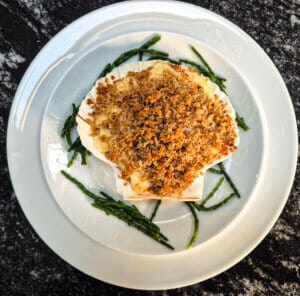
Coquilles St Jacques is a classic French dish of scallops baked in their shells with a creamy sauce and a golden gratin crust. The name translates as ‘scallops of St James,’ a reference to St James the Apostle, whose scallop shell symbol became the emblem of pilgrims on the Camino de Santiago. This recipe serves 4 people (2 scallops per shell) and takes around 15 minutes to bake at 180°C fan. The sauce is a classic béchamel — butter, flour and milk — enriched with Gruyère cheese, and the topping combines sourdough breadcrumbs, melted butter and more Gruyère to form a crisp, golden crust. Comté makes an excellent substitute if Gruyère is unavailable. The dish is served with buttered samphire, whose salty, briny flavour is a natural match for shellfish. Rated easy to medium in difficulty, Coquilles St Jacques works equally well as an elegant starter or, with the addition of extra scallops and a piped border of duchess mash, as a satisfying main course. The sauce and assembly can be prepared ahead, making it an ideal dinner party dish.
1 Introduction
The good thing about writing and cooking recipes for the website is that it takes you out of your comfort zone and makes you try new things. That’s exactly what happened this week — I ordered some scallops from Wylde Market, mainly because we love scallops and these came by the wonderful name of disco scallops, caught off the coast of Plymouth (more on that in a minute). So when they arrived, the conundrum was how to cook them. After much deliberation, I decided on a version of Coquilles St Jacques, a classic French recipe combining scallops with a rich, cheesy sauce topped with a golden gratin crust.
It’s something I’ve noticed when looking at recipes for a particular dish — they can vary so much. This was certainly the case with Coquilles St Jacques; I must have looked at ten different versions, and they were all different. Undaunted, I decided to trust my instincts and go with a hybrid version based on my own ideas. What could go wrong, I thought? Well, actually nothing — the scallops were a triumph. I was particularly worried about oven-baking them, as I’ve only ever pan-fried scallops before, but luck was on my side and 15 minutes in the oven proved to be absolutely spot on.


For the other ingredients, I used sourdough breadcrumbs, a lovely Gruyère cheese, and served the whole thing with buttered samphire. I was — and still am — really chuffed with how the dish turned out. The best news is that it’s genuinely very easy to cook, and it certainly rivals my scallops served on a bed of cauliflower purée, which is another firm favourite in this house.
2 The History of Coquilles St Jacques
Coquilles St Jacques is one of the great classics of French cuisine, and its history stretches back centuries. The name translates literally as ‘scallops of St James,’ a reference to St James the Apostle, whose symbol — the scallop shell — became one of the most recognisable icons of medieval Christendom. Pilgrims travelling the famous Camino de Santiago to the shrine of St James in Santiago de Compostela, Spain, would wear or carry a scallop shell as a mark of their journey, and over time the shell became inextricably linked with the saint’s name.
The dish itself is deeply rooted in the French culinary tradition of gratins — oven-baked preparations finished with a golden, bubbling crust. By the 19th century, Coquilles St Jacques had become a fixture of classical French restaurant cooking, typically served in the scallop shell itself with a creamy, wine-enriched sauce and a topping of breadcrumbs or cheese. Auguste Escoffier, the godfather of modern French cuisine, featured variations of the dish in his influential works, cementing its place in the classical canon.
Today it sits somewhere between a starter and a light main, and while the basic idea — scallops, cream, cheese, crumb — remains consistent, every chef and home cook tends to make it their own. Which is exactly what I did.
3 Meet the Disco Scallops — Sustainably Caught off the Plymouth Coast
Oh, I nearly forgot — the name disco scallops comes from the method used to catch these beauties. Peter fishes along the Plymouth coastline using an innovative, ultra-low impact technique where, instead of dragging heavy dredges across the seabed, he sets specialised pots fitted with soft LED lights that gently lure the scallops inside — and yes, that’s where the disco comes in! It’s a wonderfully precise, almost poetic way to fish; the seabed is left completely undisturbed, bycatch is dramatically reduced, and Peter only returns to his carefully chosen grounds when he’s confident they’ve had enough time to recover. By letting light do the work rather than brute force, he brings up clean, beautifully intact scallops while quietly protecting the ecosystems beneath him. Honestly, when I learned this, it made me appreciate every single scallop on my plate — this is such an ingenious way to catch scallops without causing mayhem to the seabed.
4 How to Buy the Best Scallops
If you can get your hands on sustainably caught scallops like these disco scallops from Wylde Market, absolutely do so — the quality really is exceptional and you’ll taste the difference. But for a good general guide, here’s what to look for when buying scallops.
Fresh scallops should be plump, firm and sweet-smelling — any hint of fishiness is a sign they’re past their best. Hand-dived or pot-caught scallops are widely considered the most sustainable option, as dredging can cause significant damage to the seabed. If you’re buying from a fishmonger, ask where and how they were caught. Diver scallops are increasingly available online and from good fishmongers.
Look for scallops still in their shell if possible — it’s the best indicator of freshness. If buying shelled scallops, avoid any that are sitting in milky liquid, which suggests they’ve been soaked in water to increase weight. Dry-packed scallops are always the better choice for cooking, as they sear and bake far more successfully.
For this recipe, large scallops work best — you want something substantial enough to hold up to the gratin topping and the heat of the oven.
5 Alternative Ingredients — Why I Did It My Way
As I mentioned in the intro, I looked at around ten different recipes for Coquilles St Jacques and every single one was different — some used shallots, some included mushrooms, several called for white wine and double cream. All perfectly valid, but I decided to go my own way and base my sauce on a classic béchamel — butter, flour and milk — which gives a wonderfully clean, velvety result that lets the scallops do the talking.
For the cheese, I used Gruyère, which melts beautifully and browns to a gorgeous golden crust. Comté is a very good alternative if you can’t get hold of Gruyère. The sourdough breadcrumbs were my own addition — blitzed from a leftover heel of a loaf, they give the topping a better texture and a subtle tang that works really well against the richness of the sauce.
For the garnish, I went with samphire, which felt like a natural choice — its salty, briny character is a perfect match for scallops, and it looks stunning piled on top of the finished dish.
One thing I noticed in several recipes was the idea of piping a border of mashed potato around the edge of the shell before baking — and I have to say, it looks absolutely wonderful. A neat crown of duchess-style mash around the scallops gives the whole thing a real old-school French bistro feel. I loved the idea, but as I was serving this as a starter, I decided to leave the potato off and keep it lighter. If you’re serving Coquilles St Jacques as a main course, though, the piped mash is a brilliant touch, and I’d definitely encourage you to give it a go.
So if you want to go down the cream, white wine and shallot route, absolutely do — you’ll find plenty of recipes that take that approach. But don’t be afraid to trust a good béchamel. Sometimes the classics are classic for a reason.
6 Step-by-Step Cooking Tips
The most important thing to get right with this recipe is not to overcook the scallops. In the oven at 180 °C fan, they need no more than 12–15 minutes — they should be just set through with a slight blush at the centre. Overcooked scallops turn rubbery and lose their sweetness, so err on the side of caution and check them a minute or two early.
Make the sauce separately and get it to a good consistency before spooning it over the scallops. It should be thick enough to coat the back of a spoon — if it’s too loose, it will run off, and the gratin won’t form properly.
Don’t skip adding the melted butter and a finely grated cheese to the breadcrumbs before they go on top. Serve the samphire lightly sautéed in a little butter and piled on top at the last moment — it wilts quickly, and you want it vibrant and green when it hits the table.
7 Recipe Variations
With mushrooms: A classic French version includes finely sliced button mushrooms sautéed into the sauce. They add an earthy depth and bulk the dish out nicely if you’re serving it as a main course.
With prawns: Some versions substitute a portion of the scallops for large prawns, which works well and brings the cost down if scallops are expensive or hard to source.
With a white wine and vermouth sauce: Substituting a measure of dry vermouth for some of the white wine gives a lovely, herbal, slightly aromatic quality to the sauce that pairs beautifully with shellfish.
Dairy-free version: Replace the cream with a good quality oat cream and use a dairy-free hard cheese — the results won’t be quite as rich, but it’s still a very satisfying dish.
As a main course: Simply increase the number of scallops to three or four per shell and serve with a simple green salad and crusty bread to mop up the sauce. Maybe add some bacon or lardons, which would work well.
8 Make-Ahead and Storage Tips
One of the great things about Coquilles St Jacques is that you can prepare much of it in advance, making it ideal for dinner parties. The sauce can be made a day ahead and kept covered in the fridge — simply reheat gently before assembling.
You can also assemble the whole dish — scallops in their shells with sauce and breadcrumbs on top — up to a few hours ahead and keep them covered in the fridge. Take them out 20 minutes before you want to cook to bring them up to room temperature, then bake as directed.
Leftover cooked Coquilles St Jacques can be kept in the fridge for up to 24 hours, though the texture of the scallops will suffer a little on reheating. Warm gently in a low oven (160°C) until just heated through — don’t be tempted to blast them on a high heat.
I wouldn’t recommend freezing the finished dish as the cream sauce tends to split and the scallops deteriorate in texture.
9 What to Serve with Coquilles St Jacques
Traditionally served as a starter, Coquilles St Jacques needs very little accompaniment — the shell is the plate, and the dish is complete in itself. A few slices of good crusty bread or a sourdough baguette to mop up any sauce that escapes the shell is all you really need.
If you’re serving it as a light main course, a simple green salad dressed with a sharp Dijon vinaigrette cuts through the richness perfectly. Alternatively, some simply cooked asparagus or tenderstem broccoli works beautifully alongside.
For something more substantial, a small portion of buttered linguine or tagliatelle alongside each shell is a lovely way to turn this into a more filling main.
10 Wine Pairing for Coquilles St Jacques
A crisp, unoaked white wine is the classic partner here. Burgundy is the traditional French choice — a good Chablis or a village-level Mâcon-Villages has the minerality and acidity to cut through the cream sauce without overwhelming the delicate scallops.
Outside of Burgundy, a quality Muscadet sur Lie from the Loire Valley is an outstanding match — the slight yeastiness and saline quality of the wine echo the sea flavours in the dish beautifully. A good Picpoul de Pinet from the South of France is another reliable option and usually excellent value.
If you prefer something a little richer, a lightly oaked Chardonnay from Burgundy or a white Rioja would also work well with the Gruyère and cream.
Avoid heavily oaked, high-alcohol whites — they’ll bulldoze the subtlety of the scallops. And while it might seem unconventional, a glass of good quality English sparkling wine is actually a brilliant pairing if you want to make an occasion of it.
11 Coquilles St Jacques — Frequently Asked Questions
What does Coquilles St Jacques mean?
It translates from French as ‘scallops of St James.’ The name refers to St James the Apostle, whose symbol is the scallop shell — long associated with pilgrims on the Camino de Santiago route to Santiago de Compostela in Spain.
What type of scallops should I use?
Large, fresh king scallops are ideal. If you can find hand-dived or pot-caught scallops like these disco scallops from Wylde Market, even better — the quality and sustainability credentials are second to none. Avoid small queen scallops for this recipe as they’ll overcook too quickly.
Can I use frozen scallops?
You can, but the results won’t be quite as good. Frozen scallops release more water during cooking, which can make the sauce watery and prevent the gratin crust from crisping properly. If using frozen, defrost thoroughly in the fridge overnight and pat dry very well with kitchen paper before assembling.
How do I stop scallops from becoming rubbery in the oven?
The key is not to overcook them. At 180°C, 12–15 minutes is enough — they should be just set through with a slight translucency at the very centre. Pull them out a minute early if in doubt. Once rubbery, there’s no coming back, so watch them carefully towards the end of cooking time.
What cheese is traditionally used in Coquilles St Jacques?
Gruyère is the classic choice, and for good reason — it melts smoothly, has a lovely nutty depth, and browns beautifully without splitting or going greasy. Comté is a very close alternative. Some versions use Emmental or a mix of cheeses. Avoid overly strong cheeses that would dominate the delicate scallop flavour.
Can I make Coquilles St Jacques ahead of time?
Yes — this is one of its great virtues as a dinner party dish. Make the sauce a day ahead and refrigerate, make sure you cover with cling film before you refrigerate to stop a skin forming, it solidifies but reheating in a pan will bring it back (you can add a little extra milk to help).
What can I serve with Coquilles St Jacques?
As a starter, all you really need is good, crusty bread to mop up the sauce. As a main, a crisp green salad, some simply cooked green vegetables, or a small portion of buttered pasta alongside each shell works beautifully. Keep it simple — the dish itself is the star.
Can I use the scallop shells to serve, and where do I get them?
Absolutely — serving in the shell is traditional and looks stunning. If your scallops don’t come with shells, you can buy cleaned scallop shells from most good fishmongers, online seafood suppliers, or kitchen shops. They’re reusable too, so worth holding onto.
What wine pairs well with Coquilles St Jacques?
A crisp, unoaked white wine is the classic partner. Chablis, Muscadet sur Lie, or Picpoul de Pinet are all excellent choices. The acidity and minerality cut through the cream sauce beautifully. Avoid heavily oaked whites — they’ll overpower the scallops.
What’s the difference between Coquilles St Jacques and scallops gratin?
In practice, very little. Coquilles St Jacques is a specific classical French dish with a cream and wine sauce, topped with cheese and breadcrumbs, baked in the shell. ‘Scallops gratin’ is a broader, more informal term for any baked scallop dish with a golden topping. Coquilles St Jacques could be described as the original and best version of scallop gratin.
What is samphire and where can I buy it?
Samphire (also known as sea asparagus or sea beans) is a coastal plant with a distinctive salty, briny flavour that makes it a natural partner for seafood. It’s increasingly available in supermarkets (look in the fish counter or vegetable aisle), from fishmongers, or online. It needs very little cooking — a quick sauté in butter for a minute or two is all it takes.
12 Final Thoughts
So, plenty of reasons to cook this recipe — let me know how you get on. I would be amazed if these didn’t receive a big thumbs up from the grateful recipients!

13 Recipe-Ingredients & Method
Coquilles St Jacques
Print RecipeIngredients
- 8 Plump scallops
- 50g Flour
- 50g Butter
- 50g Gruyère cheese finely grated
- 1 pint of milk
- For the breadcrumbs
- 60g Breadcrumbs
- 40g Butter melted
- 50g Gruyère cheese finely grated
- Small pinch of grated nutmeg
- salt & pepper to season
- 50g Samphire
Instructions
Method
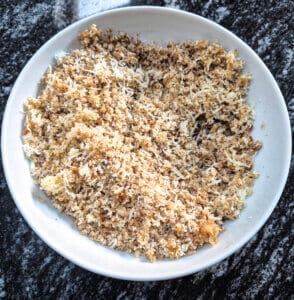
Make the breadcrumbs If you don’t have stale bread to hand, simply leave two slices of sourdough out overnight to dry out, then blitz in a blender — it really is as simple as that. Set aside.
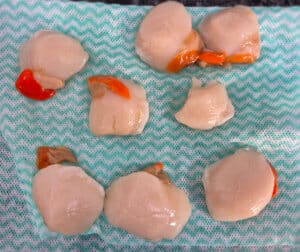
Prepare the scallops Remove the scallops from the fridge and pat dry with kitchen paper.
Make the béchamel sauce Melt the butter in a pan over a medium heat — you’re creating a classic white roux. Add the flour in two stages, mixing well and stirring it into the butter after each addition. Gradually add the milk, stirring or whisking continuously over a medium-high heat until the sauce begins to boil. Lower the heat and continue whisking for around 10 minutes, or until the sauce has thickened nicely. Season with a little salt and pepper, add a grating of nutmeg, then stir in half the Gruyère. Keep the sauce warm over a low heat while you prepare the breadcrumb topping. 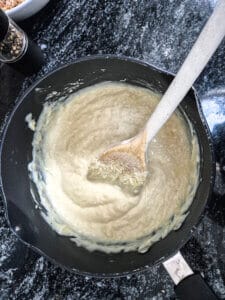
Make the breadcrumb topping Preheat the oven to 180°C fan. Melt the butter in a small pan. In the meantime, mix the remaining Gruyère into the breadcrumbs, then pour in the melted butter and mix until everything is well combined.
Build the dish Place two scallops into each shell and spoon the béchamel sauce generously around and over them. Top with the breadcrumb mixture, making sure to cover completely — don’t be shy with either the sauce or the breadcrumbs, as both are essential to getting that golden gratin crust.
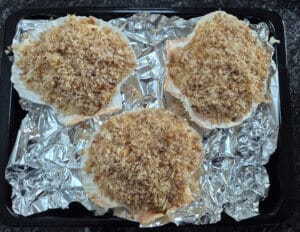
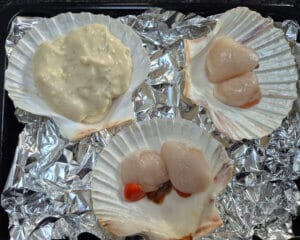
Bake Place the shells on a baking tray and bake for around 15 minutes. A handy tip — scrunch a sheet of aluminium foil across the tray first, as this stops the shells from sliding around in the oven.
Prepare the samphire While the scallops are in the oven, gently heat the samphire in a little butter. It only takes a couple of minutes to warm through — you want it bright and vibrant, not overcooked.
Serve After 15 minutes, remove the scallop shells from the oven. Add the samphire either around or on top of the shells — I think it looks better piled on top, but it’s your call. Serve immediately. Bon appétit!