Table of Contents
Written by Martin Seymour | Editor, The Mayfair Foodie | About Me

The great thing about risotto rice is that it’s happy to play a supporting role to great ingredients; in this recipe, the humble broad bean, along with some great back bacon that I had in the fridge. Both came from Wylde Market, the online farmers’ market.
Originally, I thought of using the broad beans with something Spanish-inspired — broad beans with poached eggs and chorizo make a great lunch — but I was looking for inspiration for a summer dinner, and I thought they would be great in a risotto. I was not wrong. Although very simple, with the addition of bacon (lardons or pancetta would also work well) it was the perfect combination and made a flavoursome supper.
I made the stock for the risotto by boiling the discarded pods with an onion and a carrot. They made a great stock and, somehow, it felt more satisfying not to waste the shells.
1 Why Broad Beans and Bacon Work So Well
Broad beans have a green, faintly grassy sweetness and a soft, floury texture that can go a little flat on its own. Bacon fixes both problems at once. The salt sharpens the sweetness, the smoke gives the dish a savoury backbone, and the rendered fat carries all of it through the rice. You end up with something that tastes far more considered than the short ingredient list suggests.
It’s also a genuinely seasonal risotto. British broad beans are at their best from June through to August, and this is the dish I keep coming back to in those months — light enough for a warm evening, but still substantial enough to be dinner.
2 Other Names for Broad Beans
Broad beans go by a surprising number of names, which is worth knowing if you’re shopping in a greengrocer or reading a recipe from abroad:
- Fava beans — the Italian name, and the one you’ll usually see in America. Same bean.
- Faba beans — an older spelling, still used in agricultural and seed catalogues.
For this risotto you want fresh broad beans in the pod, or good frozen ones. What you don’t want are dried fava beans, which are a different proposition altogether and need soaking and long cooking.
3 Podding and Double-Podding
Fresh broad beans need two rounds of shelling, and I know that sounds like a faff. The first is easy: run your thumb down the seam of the pod and the beans pop out. The second — slipping each bean out of its pale outer skin — is the fiddly one, but it’s the difference between a dull, slightly bitter risotto and a vivid green one.
Boil the shelled beans for two to three minutes, drain them, and cool them under cold water. Then pinch the skin at one end and squeeze gently; the bright green bean underneath will shoot straight out. Put a plate on your lap, do it in front of the radio, and it takes ten minutes.
Worth knowing: if your beans are very young and small — the first of the season, no bigger than your little fingernail — you can skip the second podding entirely. The skins are tender enough to eat.
4 A Free Stock from the Pods
Don’t throw the pods away. Broad bean pods make a light, sweet, distinctly green stock that suits this risotto far better than a shop-bought cube ever will, and it costs you nothing you weren’t already going to bin.
Roughly chop the empty pods, put them in a pan with a quartered onion and a chopped carrot, cover with about 1.5 litres of water and simmer gently for 30 to 40 minutes. Strain it, season lightly, and keep it hot on the back of the hob ready for the risotto. If you’re short of time, a good chicken or vegetable stock works perfectly well — but do try the pod stock at least once.
5 Ingredients and What to Look For
Broad beans. Look for firm, bright green pods with no brown patches or flattened sections. Smaller pods generally mean younger, sweeter beans. You’ll need roughly 600g of beans in the pod to give you the 200g of shelled beans this recipe calls for, so buy generously.
Bacon. I used four thick rashers of back bacon, cut into strips about 2cm wide. Smoked or unsmoked is your call — smoked gives you more depth, unsmoked lets the beans come forward. Lardons or diced pancetta work just as well and save you the chopping.

Rice. Arborio, 300g for four people. Carnaroli if you have it. Never rinse it — the surface starch is exactly what makes the risotto creamy.
Parmesan. Freshly grated, and don’t skimp. There’s no fish in this one, so the usual seafood-risotto debate doesn’t apply — parmesan belongs here.
6 What to Serve With It
Very little, is the honest answer. A risotto this rich wants nothing more than a sharply dressed green salad afterwards, in the Italian way, and a cold glass of something white and unoaked — a Soave or a dry Italian white does the job nicely. If you want to stretch it to a dinner party, serve smaller portions as a starter ahead of something simply grilled.
7 Broad Bean Risotto FAQs
Can you use frozen broad beans?
Yes, and there’s no shame in it — I use them happily out of season. Frozen broad beans are picked and frozen young, so they’re often sweeter than tired fresh ones sitting in a shop in September. Cook them from frozen for two minutes, then double-pod them exactly as you would fresh. You’ll need about 250g frozen to end up with 200g podded.
Do you have to double-pod broad beans?
Not always, but usually. The outer skin turns tough and slightly bitter as the beans mature, and it dulls that bright green colour. Very young, small beans can go in as they are. Anything bigger than a fingernail is worth the second podding.
Can you make broad bean risotto ahead of time?
You can par-cook the rice restaurant-style — take it to about half done, spread it on a tray to cool fast, and chill it for up to three days. Keep the beans and bacon separate and stir them in when you finish the risotto with fresh stock and the mantecatura. Don’t cook the beans into the rice in advance; they’ll go grey.
Can you make it vegetarian?
Easily. Leave out the bacon and use the broad bean pod stock, then finish with plenty of parmesan, a squeeze of lemon and a handful of chopped mint. Mint and broad beans are a classic pairing, and it gives you back some of the lift the bacon was providing.
What can I use instead of bacon?
Pancetta or lardons are the obvious swaps and behave identically. Crisped prosciutto crumbled over the top at the end is a slightly smarter version. Chorizo works too, though it will take the dish in a Spanish direction and colour the rice orange.
How many broad beans do I need per person?
Around 50g of podded beans per person for a main course risotto — 200g for four. That’s roughly 600g of beans still in their pods, so don’t be alarmed by how little you’re left with after shelling.
8 Recipe-Ingredients & Method
Broad Bean Risotto with Bacon
Print RecipeIngredients
- 200g shelled and double-podded broad beans (about 600g in the pod, or 250g frozen)
- 4 thick rashers of back bacon (200g), cut into 2cm strips
- 300g arborio rice
- 1.25 litres hot stock (broad bean pod, chicken or vegetable)
- 150ml dry white wine
- 1 onion or 2 banana shallots, finely chopped
- 1 stick celery, finely chopped
- 1 clove garlic, finely chopped
- 75g cold butter
- Freshly grated parmesan, a good handfu
- 1 Tbsp Olive oil
- Salt and freshly ground black pepper
Instructions
Pod the broad beans by running your thumb down the seam of each pod. Boil the shelled beans for 2–3 minutes, drain and cool them under cold water, then pinch the skin at one end of each bean and squeeze so the bright green bean slips out. Set aside. (Skip the second podding if the beans are very small and young.)
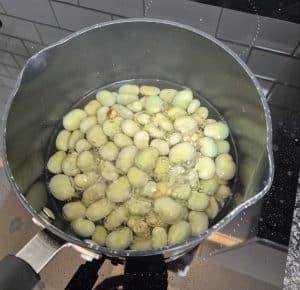

If you’re making the pod stock, roughly chop the empty pods and simmer them with a quartered onion and a chopped carrot in 1.5 litres of water for 30–40 minutes. Strain, season lightly and keep hot alongside the risotto pan.
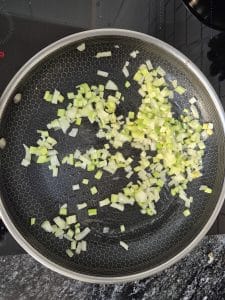
Finely chop onion, celery & garlic
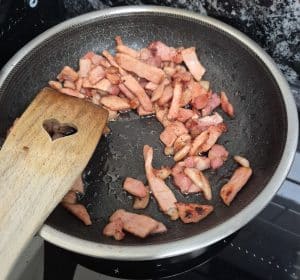
Cut bacon rashers into strips. Fry the bacon strips in a dry pan until crisp, then lift them out and set aside. Leave the rendered fat in the pan — you’ll build the soffritto in it.
Soften a finely chopped onion (or two banana shallots), a stick of celery and a clove of garlic in the bacon fat with a little butter, over a low heat, for about five minutes until soft but not coloured. This is the soffritto.
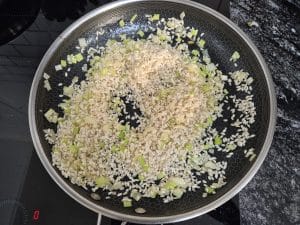
Add the rice, turn up the heat and stir for a minute or so until the grains are coated and the edges turn translucent. This is the tostatura. Pour in a glass of white wine and let it cook away.
Turn the heat down and add your hot stock a ladle at a time, stirring as you go and letting each ladle be absorbed before the next. Around 15 to 18 minutes.
When the rice is nearly there — tender with the faintest bite — stir through the broad beans and the crisp bacon so they warm through in the last minute or two.
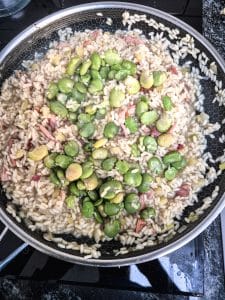
Take the pan off the heat, lid on, rest for one minute. Then add 75g of cold butter and a good handful of parmesan and roll the pan in a gentle wave motion until the risotto is glossy and rippling. This is the mantecatura, and it’s what makes it.
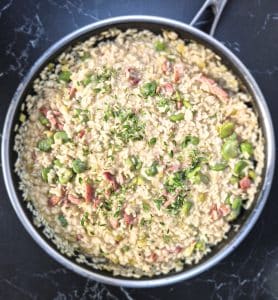
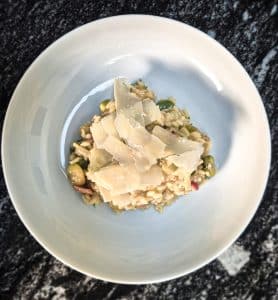
Timing note: add the beans late. They’re already cooked from the podding stage, and if they sit in the pan too long they lose their colour and turn mealy. A minute or two before the mantecatura is exactly right.