Table of Contents
1 The overlooked French classic that deserves your attention
Written by Martin Seymour | Editor, The Mayfair Foodie | About Me


White wine coq au vin (coq au vin blanc) is a classic French braised chicken dish that uses white wine and cream instead of the traditional red wine sauce. Originating in Alsace, where it’s known as coq au Riesling, this lighter variation features chicken legs or thighs slowly braised with shallots, mushrooms, lardons, and herbs before finishing with double cream for a silky, elegant sauce. The dish takes approximately 90 minutes to prepare and serves 4 people. The best white wines to use include Alsatian Riesling, unoaked Chardonnay, Pinot Gris, or Loire Valley Sauvignon Blanc – avoid sweet wines or heavily oaked varieties. White wine coq au vin can be made up to two days in advance and reheated gently, making it ideal for dinner parties. Serve with creamy mashed potatoes and green vegetables.
2 The Overlooked French Classic
White wine coq au vin seems like a younger, quieter sibling – we all know coq au vin, but the white wine version seems to be overlooked on dinner tables and restaurant menus, which is why I’m adding this to my list of recipes. Make no mistake, this is a great dish and deserves to have its share of the limelight. Whilst I’m a fan of the red wine version of coq au vin, I feel the addition of cream in the sauce of the white wine version works so well with the chicken.
Talking of chicken, I’ll address the fact that traditionally the cockerel was used, hence coq au vin, but nowadays everybody uses chicken. I had cockerel once, and actually I don’t think it was in a coq au vin – it was perfectly good, but less meat on it than a chicken. Leave the cockerel to get on with other things.
For my recipe, I used chicken legs, because I wanted to go with organic chicken from the online farmers’ market (Wylde Market) and on ordering, they didn’t have chicken thighs. In an ideal world, I like to use chicken legs and thighs in a coq au vin, but that’s the point about the market and the producers on the marketplace – you order what they have on offer at the time and actually, I like that. For those who are interested, the chicken legs we ate were slow-grown, organic Hubbard chicken legs. They were delicious. Will chicken breasts work? The simple answer is yes, but I much prefer legs and thighs for slow-cooked recipes.

I served the coq au vin with creamy mash and green beans – it was a perfect alternative to a family Sunday roast. Just for reference, the potatoes and cream were also ordered from Wylde Market. What else can you serve? Roast potatoes or new potatoes would also work well. I’ve seen recipes suggesting rice and tagliatelle; both work with the sauce so why not? As for other vegetables, because of the sauce, any green vegetables, spring greens, kale, broccoli would be nice or peas will work. I’m not sure about carrots or root vegetables, and because there is a lot going on, I think you only need one side vegetable.
For fans of the red wine version, I’ll be featuring my recipe in the near future.
3 What is White Wine Coq Au Vin?
White wine coq au vin, also known as coq au vin blanc, is the lighter, creamier cousin of the famous Burgundian classic. Instead of the robust red wine and deeply savoury sauce of traditional coq au vin, this version uses white wine and finishes with cream, creating a dish that’s elegant, refined, and somehow feels more appropriate for spring and summer dining than its winter-weight sibling.
The fundamentals remain the same – chicken (traditionally cockerel, but nowadays always chicken) is browned and then slowly braised with wine, mushrooms, onions or shallots, and aromatics until the meat is fall-off-the-bone tender and the sauce has reduced to something gloriously rich. The magic happens in that slow braise, where the wine mingles with the chicken juices and the flavours concentrate into something much greater than the sum of its parts.
What sets the white wine version apart is that final addition of cream, which transforms the sauce into something silky and luxurious. Where red wine coq au vin is earthy and robust, this is refined and delicate. The chicken flavour comes through more clearly without the tannins and deep fruit notes of red wine competing for attention.
In Alsace, where this dish is particularly beloved, they often use Riesling and call it coq au Riesling – the slight acidity and fruit notes of a good Alsatian Riesling work beautifully with the cream and chicken. Other regions use whatever local white wine they have to hand, which is entirely in the spirit of French home cooking – use what’s good and local.
It’s the kind of dish that feels special enough for a dinner party but is actually remarkably forgiving to make. The slow braise means you can’t really overcook it (within reason), and it actually benefits from being made ahead and reheated, making it perfect for entertaining when you want to spend time with guests rather than stuck in the kitchen.
4 History of Coq Au Vin: From Red Wine to White
The story of coq au vin starts, like so many great French dishes, with necessity rather than luxury. The classic red wine version from Burgundy was originally a way to deal with an old cockerel – a bird past its laying days whose tough, stringy meat needed long, slow cooking in wine to become edible. The wine acted as a tenderiser and flavour enhancer, transforming something that would otherwise be fit only for stock into a celebration dish.
Legend has it that Julius Caesar enjoyed coq au vin during the Gallic Wars, though this story is almost more myth than truth – the French love to claim ancient Roman origins for their dishes. What’s more likely is that coq au vin in some form has been made by French farmers for centuries, using whatever wine was local and cheap enough to cook with. In Burgundy, that meant red wine. In Alsace and other white wine regions, it meant white.
The white wine version, coq au vin blanc or coq au Riesling, likely developed in Alsace and the Loire Valley, where white wine was the local product and red wine would have been an expensive import. Why cook with expensive Burgundy when you’ve got perfectly good local Riesling or Muscadet? The addition of cream is a natural evolution – both Alsace and Normandy (another region known for white wine, coq au vin) are big dairy regions where cream was cheap and plentiful.
What’s interesting is how the white wine version remained relatively obscure compared to its red wine sibling. When coq au vin became internationally famous in the mid-20th century – helped along by Julia Child featuring it in ‘Mastering the Art of French Cooking’ – it was always the red wine Burgundian version that got the spotlight. The white wine version remained more of a regional speciality, something you’d find in Alsace but rarely in Parisian restaurants or international French cookbooks.
I first came across the white wine version years ago in a small brasserie in Lyon – it was on the menu as a regional speciality and I remember thinking it was one of those dishes that deserved far more attention than it got. The trend is shifting as people seek lighter alternatives to rich, heavy dishes. White wine coq au vin provides all the comfort and elegance of the traditional recipe while being more suited to modern dining habits and, dare I say it, more suited to a British family dinner than an hours-long French Sunday lunch (though I suspect most French grandmothers would have something to say about that). Nowadays, we tend to eat lighter compared to previous generations, and a creamy white wine sauce feels less heavy than the dark, intense sauce of red wine coq au vin, even though the calorie difference is likely minimal.
As previously mentioned, it’s also worth noting that the modern version almost never uses actual cockerel – chickens are more tender, readily available, and frankly more appealing to contemporary palates. An old cockerel needs hours of braising to become tender, whereas a good chicken will be perfectly cooked in 45 minutes to an hour.
5 Which White Wine to Use for Coq Au Vin
The golden rule of cooking with wine applies here: don’t cook with anything you wouldn’t drink. You don’t need to splash out on a grand cru, but you do need something decent that you’d be happy to pour yourself a glass of. The wine is a major flavour component of the sauce, not just a cooking liquid, so quality matters. That said, don’t overthink it – I’ve made this with whatever white was open in the fridge and it’s always turned out well.
Riesling is the traditional choice, particularly for coq au Riesling from Alsace, and it’s my personal favourite for this dish. An Alsatian Riesling brings beautiful acidity and stone fruit notes that work brilliantly with chicken and cream. It’s not sweet (despite Riesling’s undeserved reputation) – Alsatian Riesling is typically bone dry with enough acidity to cut through the cream and prevent the sauce from becoming cloying. If you can find a decent German Riesling (look for “trocken” on the label, meaning dry), that works just as well.
Chardonnay is another excellent option, in unoaked or lightly oaked versions. A good Chablis or white Burgundy (Mâcon, for example) brings minerality and elegance without overwhelming the dish with oak flavours. Avoid heavily oaked New World Chardonnays – all those vanilla and butter notes from oak ageing will compete with your sauce rather than complement it.
Pinot Grigio or Pinot Gris works well if you want something neutral that won’t dominate. Pinot Grigio is lighter and crisper (Italian style), while Pinot Gris (particularly from Alsace) is richer and more full-bodied. Either works, though I’d lean towards Pinot Gris for a bit more body.
Sauvignon Blanc is perfectly acceptable; avoid the very grassy, herbaceous New Zealand styles, which might be a bit much. A Loire Valley Sauvignon Blanc (Sancerre, Pouilly-Fumé) is more restrained and works beautifully.
Avoid:
- Anything sweet – dessert wines, late harvest wines, or Moscato will make your sauce weird and cloying
- Very oaky wines – those big, buttery, heavily oaked Chardonnays will overpower the dish
- Very cheap wine – if it tastes harsh or acidic in the glass, it’ll taste harsh and acidic in your sauce
As a general principle, if you’re going French with the recipe, try to go French with the wine. A decent supermarket Côtes du Rhône Blanc, Entre-Deux-Mers, or Alsace Riesling will cost you £8-12 and give you exactly what you need. Look out for their 20% discount offers and stock up thats what I do. You’ll use about half a bottle for the dish, so you can drink the rest with dinner – always a good test of whether you’ve chosen the right wine.
6 White Wine Coq Au Vin vs Red Wine Coq Au Vin
Both versions follow the same basic technique – brown the chicken, build the sauce with wine and aromatics, braise slowly until tender – but they’re quite different dishes in terms of flavour and presentation.
Flavour Profile
Red wine coq au vin is robust, earthy, and deeply savoury. The tannins and fruit notes of red wine, along with a slug of brandy, combine with chicken to create something rich and warming – classic cold-weather comfort food. It’s the kind of dish that wants crusty bread and a hearty appetite.
White wine coq au vin is lighter, more delicate, and – thanks to the cream – silkier in texture. The chicken flavour comes through more clearly, and the sauce feels elegant rather than rustic. It’s refined without being fussy, which is a neat trick to pull off.
If I’m honest, I marginally prefer the white wine version – the cream makes it feel like more of a complete dish, and I find it pairs better with the sides I like to serve. The red wine version is wonderful, don’t get me wrong, but the white feels slightly more versatile. That said, I’d choose red for a cold January evening and white for pretty much any other time of year.
7 Frequently Asked Questions
What’s the difference between coq au vin blanc and coq au Riesling?
They’re essentially the same dish – coq au vin blanc just means “chicken in white wine” and can use any white wine, while coq au Riesling specifically uses Riesling. The Alsatian version with Riesling is the most traditional, but you’ll find variations across France using whatever local white wine is available. The technique and final result are virtually identical regardless of which white wine you use.
Can I make white wine coq au vin without cream?
Yes, though you’ll lose that silky, luxurious texture that defines the dish. Without cream, you essentially have chicken braised in white wine, which is perfectly nice but not quite the same thing. If you can’t do dairy, you could try coconut cream as a substitute, though it will add a slight coconut flavour. Some recipes finish with crème fraîche instead of double cream, which gives a tangier result – that works well too.
Can I use chicken breasts instead of legs?
You can, but I’d strongly recommend against it. Chicken breasts dry out easily during the long braise that coq au vin requires, whereas legs and thighs stay moist and tender. Dark meat also has more flavour and stands up better to the wine and cream sauce. If you absolutely must use breasts, add them later in the cooking process (about 20 minutes before the end) so they don’t overcook, and consider using bone-in, skin-on breasts, which fare better than boneless skinless.
Do you need to marinate the chicken first?
No, there’s no marinating required. The chicken browns first to develop flavour and colour, then braises in the wine sauce, which provides all the flavouring it needs. Some recipes suggest marinating the chicken in wine overnight, but I’ve never found it makes enough difference to be worth the extra step. The long, slow braise is what makes this dish special, not advanced marinating.
Can you make white wine coq au vin in advance?
Absolutely – in fact, it’s better made ahead. The flavours develop and meld as it sits, and reheating is easy. Make it up to two days ahead, let it cool completely, then refrigerate. Reheat gently on the stove or in a low oven (160°C) until heated through. You might need to add a splash of water or stock if the sauce has thickened too much in the fridge. It’s perfect dinner party food precisely because you can do all the work ahead and just reheat when needed.
How long does white wine coq au vin take to cook?
Active cooking time is about 30 minutes (browning chicken, sautéing vegetables, building the sauce), then it needs 45-60 minutes of gentle braising. So budget about 90 minutes total from start to finish. It’s not a quick weeknight dinner, but it’s also not demanding – once it’s braising, you can largely ignore it except for the occasional stir. The actual hands-on time is quite minimal.
Can I freeze white wine coq au vin?
Yes, though cream-based sauces can sometimes split when frozen and reheated. If you know you’re going to freeze it, you might want to freeze it before adding the cream, then stir in the cream when you reheat. It’ll keep frozen for up to three months. Defrost overnight in the fridge, then reheat gently on the stove, stirring occasionally. If the sauce has split slightly, a good stir or quick blitz with a stick blender usually brings it back together.
What can I substitute for white wine in coq au vin?
Honestly, not much – the wine is fundamental to the dish. You could try white vermouth (which is essentially fortified wine) diluted with a bit of chicken stock, or a very dry white grape juice with a tablespoon of white wine vinegar for acidity, but neither will give you the same complexity and depth. If you can’t use alcohol, you might be better off making a different chicken dish entirely rather than a compromised version of coq au vin. The wine is the point.
Is white wine coq au vin traditional French cooking?
Absolutely, particularly in Alsace, where coq au Riesling is a regional speciality. It’s less famous internationally than the Burgundian red wine version, but it’s just as authentically French. French home cooking has always been about using what’s local and available – in white wine regions, that meant cooking with white wine. It’s traditional, just regionally specific rather than nationally famous.
Why is my coq au vin sauce too thin/thick?
Too thin: You haven’t reduced the sauce enough. After adding the wine, let it bubble away until it’s reduced by about half before adding stock. At the end of cooking, if it’s still too thin, remove the chicken and boil the sauce hard for a few minutes to reduce and concentrate. Too thick: You’ve reduced it too much or the flour (if you used it for dredging) has over-thickened it. Add a splash of stock or water to loosen. Remember the sauce will thicken slightly as it cools, so it should look slightly looser than you want when it’s hot.
Can you make coq au vin blanc in a slow cooker?
Yes, though you’ll still need to brown the chicken and build the sauce base on the stove first – don’t skip this step as it’s where most of the flavour develops. Once you’ve browned everything and added the wine and stock, transfer to a slow cooker and cook on low for 4-5 hours or high for 2-3 hours. Add the cream in the last 15 minutes. The results are good, though you won’t get quite the same depth of flavour as traditional stovetop braising because you’re not getting that gentle reduction of the sauce.
8 Recipe-Ingredients & Method
White Wine Coq Au Vin
Print RecipeIngredients
- 4 large free range chicken legs (you can use chicken thighs)
- 12 shallots or baby onions peeled
- 300ml of chicken stock
- 480ml of white wine (see my notes on the wine)
- 100ml of cream
- 200g Button or chestnut mushrooms
- 2 gloves of garlic
- 70g unsalted butter
- 125g Lardons or 4 rashers of back bacon chopped
- 1 bay leaf
- 2 tbsp of olive oil
- Small handful of parsley
- 2 sprigs of Thyme
- 1tbsp of cornflour mixed in cold water
Instructions
Method
- Peel the shallots (or baby onions) and lightly dust the chicken pieces with flour, shaking off any excess.
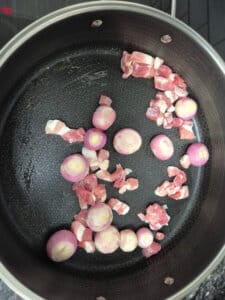
- Heat the olive oil in a large, ovenproof pan or casserole dish over a medium heat. Add the shallots and lardons, cooking gently until they take on a golden colour. Remove with a slotted spoon and set aside in a bowl.
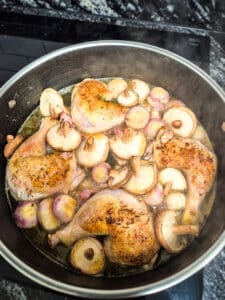
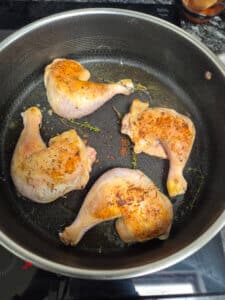
- Add the chicken pieces to the pan and brown the skin on all sides. Return the shallots and lardons to the pan along with the thyme, bay leaf, mushrooms, and garlic. Stir gently, being careful not to burn the garlic.
- Pour in the white wine and let it bubble away until reduced by half. Add the chicken stock and bring to a gentle simmer.
- Cover with a lid and transfer to a preheated oven at 180°C (fan-assisted) for 50 minutes.
- Remove from the oven and stir in the cream and butter. Return to the oven, uncovered, for a further 10 minutes. Tip: Take the cream out of the fridge 15 minutes beforehand to prevent it from splitting.
- If the sauce needs thickening, mix two teaspoons of cornflour with a splash of cold water until smooth, then stir into the sauce.
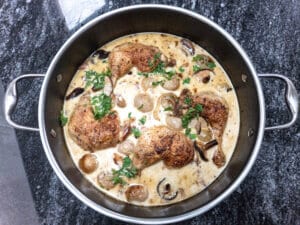
- Scatter over the chopped parsley and serve with creamy mashed potatoes and vegetables of your choice.




Some of the items in the recipe seem to be missing from the ingredient list
So sorry Stephanie, thanks for pointing out our omissions. Ive updated the recipe
Best Martin