Table of Contents

As I’m writing this, I should be on the island of Krabi in Thailand; instead, I’m home in front of my laptop. The world’s leaders had other ideas and decided to have another tiff, and because our flight to Thailand was going via Doha, the holiday was cancelled. Obviously, it’s disappointing, but missing a holiday is small beer when you consider the impact on other people.
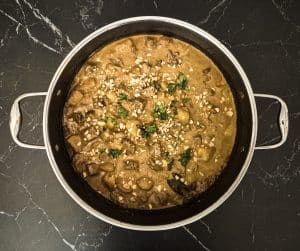
Anyhow, to cheer myself up, I decided to cook one of my favourite Thai dishes, a beef massaman curry, this time using organic diced beef. Like most curry sauces, it works equally well with other meats — I like it with lamb, duck and chicken. But today it’s beef, no ordinary beef, pasture-fed organic beef from Wylde Market.
This curry is slow-cooked, building layers of flavour. Generally speaking, the sauce is not that hot, cooled by the coconut milk, but of course, you can spice it to your preference. I’ve included a recipe for the massaman paste, or you can buy one from supermarkets. I’ve made my own paste in the past, but on this occasion, I picked one up from a local Thai supermarket — and I’m encouraged to see it was actually made in Thailand.
The good thing about this recipe is that it’s easy to make, though you do need to allow time for the meat to soften to the point of falling apart. Using beef, that means at least 2 hours in the oven and resting for 15 minutes. Duck takes no more than 30 minutes, and chicken around 45.
I have to say the results of my massaman were very good — I’m not blowing my own trumpet, it’s all down to the ingredients and the blend of the four Thai flavour profiles: sweet, sour, spicy and salty.
Enjoy!
1 What is Massaman Curry?
Massaman curry occupies its own unique corner of Thai cuisine. Unlike the fiery green or red curries most people are familiar with, massaman is notably mild, deeply fragrant and has a warmth that comes more from whole spices than raw heat. It’s thought to have Persian or Malay origins, which explains why you’ll find ingredients like cinnamon, cardamom, bay leaves and star anise alongside the more familiar Thai staples of lemongrass, galangal and kaffir lime leaves.
It’s widely considered one of the world’s great curry dishes — and for good reason. The balance of those four Thai flavour profiles (sweet, salty, sour and spicy) is beautifully calibrated, with the coconut milk softening everything into something genuinely comforting. Slow-cooking tough cuts of beef in this sauce is nothing short of transformative.
2 Why Beef Works So Well in a Massaman Curry
Massaman curry is one of those dishes that was practically designed for cheaper, tougher cuts of beef. The long, slow oven cook breaks down the collagen in cuts like diced chuck or braising steak, transforming them into something extraordinarily tender — pieces that quite literally pull apart at the touch of a fork.
3 The Star Ingredients: Organic Beef and Potatoes from Wylde Market
For this recipe, I turned to Wylde Market, an online farmers’ market that connects you directly with small British producers. The organic diced beef I used here is pasture-fed, and you can tell — it has real depth of flavour and a clean, honest richness that supermarket beef simply can’t match. When you’re building a sauce as complex as massaman, starting with quality beef makes an enormous difference to the finished dish.
The potatoes are from Wylde Market too, and they’re every bit as good. Massaman curry is one of the few Thai dishes that traditionally includes potato, and choosing the right variety matters. You want something waxy enough to hold its shape through the long braise but able to absorb all that coconut and spice goodness. Wylde Market’s organic potatoes do exactly that — they drink in the sauce and become little flavour bombs in their own right.
You can order both the beef and potatoes, along with a huge range of other seasonal British produce, directly from Wylde Market at . It’s genuinely one of the best ways to support British farming while cooking well.
4 Making the Massaman Paste — or Buying One
Massaman paste is the aromatic backbone of this dish. Making your own is a satisfying project — you’ll toast whole spices, blitz lemongrass and galangal, and end up with a paste that’s considerably more vibrant than anything from a jar. If you want to go down that route, I’ve included a paste recipe below.
That said, there’s absolutely no shame in buying a good-quality paste. The key is to look for one actually made in Thailand rather than a generic supermarket version — there really is a difference. Thai supermarkets and Asian grocers are your best bet.
5 Key Ingredients for Beef Massaman Curry
Aside from the beef and potatoes, a few other ingredients are worth a mention:
- Coconut milk: Use full-fat — not the light version. It’s what gives massaman its characteristic creaminess and tempers the heat.
- Fish sauce: Provides the salty, umami depth. Don’t be put off by the smell in the bottle — it cooks down beautifully.
- Tamarind paste: This brings the sour note. Available in most supermarkets now, either as a block or ready-to-use paste.
- Palm sugar (or brown sugar): Rounds out the sweetness. Palm sugar is more authentic; light brown sugar works perfectly well as a substitute.
- Roasted peanuts: Scattered through the sauce and used as garnish. They add a gentle crunch and a nutty richness.
- Kaffir lime leaves and cinnamon stick: These whole spices are what set massaman apart from other Thai curries. Don’t skip them.
6 Tips for Cooking the Best Beef Massaman Curry
A few things I’ve learnt from making this dish a few times:
- Fry the paste properly before adding the liquids. Cook it in the oil for a couple of minutes until really fragrant — this is where the sauce starts building its depth.
- Brown the beef first in batches if necessary.
- Add the potatoes in the last hour. Put them in at the start and they’ll turn to mush. Add them later, and they’ll hold their shape while still absorbing all that gorgeous sauce.
- Taste and adjust at the end. The balance of fish sauce (salt), tamarind (sour) and sugar (sweet) is personal — give it a final taste before serving and tweak to your preference.
- Let it rest. Once out of the oven, give it 15 minutes before you serve. The sauce thickens slightly and the beef relaxes.
7 Can I Use Other Meats?
Absolutely. Massaman paste works beautifully with other proteins. Here’s a quick guide to adapting cooking times for massaman:
- Lamb: Diced shoulder works wonderfully here for a slightly richer, more robust flavour. Similar cooking time to beef — 2 hours minimum.
- Chicken: Thighs (bone-in if possible) are far better than breasts here. Around 45 minutes in the oven.
- Duck: Duck legs make a fantastic massaman. No more than 30 minutes — duck can dry out if overcooked.
- Vegetarian/vegan: Swap the beef for firm tofu or chickpeas and use soy sauce in place of fish sauce. Reduce the cook time to around 30 minutes.
8 What to Serve with Beef Massaman Curry
Jasmine rice is the natural partner here — its subtle floral fragrance complements the richness of the sauce perfectly. I always make more than I think I need, because the sauce is just too good not to mop up every last drop.
Roti or flatbreads are another great option if you want to keep things more informal. A few fresh accompaniments really lift the dish: sliced cucumber, pickled shallots, a squeeze of lime, toasted peanuts and fresh coriander. Thinly sliced red chilli adds a bit of fire if you want it.
9 Make Ahead, Leftovers and Freezing
Good news: beef massaman curry is one of those dishes that actively improves the next day. The sauce thickens, the spices deepen, and the beef somehow gets even more tender. It’ll keep in the fridge for 3 days without any problems .
It also freezes brilliantly — just be aware that the potatoes can go a little watery on defrosting. If you’re planning to freeze it, either leave the potatoes out and add fresh ones when you reheat, or accept that they’ll be a bit softer. Reheat gently on the hob with a splash of water or coconut milk to loosen the sauce.
10 Frequently Asked Questions
Is beef massaman curry spicy?
Not particularly — it’s one of the mildest Thai curries. The coconut milk does a great job of softening the heat from the paste. That said, you can absolutely add more fresh chilli or paste to increase the spice level if you prefer things hotter.
Which cut of beef is best for massaman curry?
Braising steak or diced chuck is ideal — both have enough fat and connective tissue to break down beautifully. For more on choosing the right beef for slow cooking, my posts on beef short ribs and beef brisket both cover this in detail. Avoid anything too lean — it’ll dry out and won’t have the richness this dish needs.
Can I make massaman curry on the hob rather than in the oven?
Yes. Use a heavy-based casserole, bring to a very gentle simmer, put the lid on and cook on the lowest heat possible. The oven method is slightly more forgiving as the heat is more even, but the hob works well if you keep a close eye on it and stir occasionally.
What’s the difference between massaman and panang curry?
Both are rich, coconut-based curries, but quite different in character. Panang is thicker, spicier and more intensely flavoured, with kaffir lime leaves prominent throughout. Massaman is milder, has more whole spices, and typically includes potatoes and peanuts — giving it a heartier, more stew-like quality.
Do I have to make the massaman paste from scratch?
Not at all. A good-quality bought paste works perfectly well. Look for one made in Thailand (Thai supermarkets and Asian grocers are your best bet) rather than a generic supermarket version — the difference in quality is noticeable.
Can I use light coconut milk?
You can, but I’d strongly recommend full-fat. The reduced fat content in light coconut milk means the sauce won’t be as rich or creamy, and it’s more likely to split during cooking. Massaman is meant to be indulgent — don’t hold back.
What other slow-cooked beef dishes do you recommend?
If you love the hands-off, long-cook approach, there’s a lot to explore. My beef bourguignon is the French classic done properly, my beef short ribs in red wine produce one of the most deeply glossy sauces I’ve made, and my slow-cooked beef brisket is a brilliant Sunday roast alternative. For a mince-based comfort food option, the slow -cooked spaghetti bolognese is also well worth your time.
11 How to Make Massaman Paste — The Easy Blender Method
I’ll be honest with you: I have a perfectly good pestle and mortar sitting in my kitchen, and I almost never use it for paste. Life’s too short, and a decent blender does a genuinely excellent job. I use a coffee blender for mixing spices. The purists will tell you that pounding releases more essential oils. Maybe they’re right. But what I can tell you is that this blender paste produces a massaman that I’d be happy to serve to anyone — and it takes about fifteen minutes rather than forty.
The key to a good blender paste is toasting the dry spices first. This is the step that really matters and it’s non-negotiable — a dry pan, medium heat, two or three minutes. You’ll know when it’s ready because your kitchen will start to smell extraordinary. After that, soak your dried chillies to soften them up, and the blender does the rest.
This recipe makes enough paste for one batch of massaman curry (serving 4–6). It keeps in the fridge for a week in a sealed jar, or you can freeze it in ice cube trays and pull out however much you need.
Ingredients (makes enough for one batch of curry, serving 4–6)
Dried spices (to toast):
- 1 tsp cumin seeds
- 1 tsp coriander seeds
- 4 cardamom pods — seeds only, discard the husks
- 4 cloves
- ½ tsp white peppercorns (or white pepper)
- ¼ tsp ground cinnamon (or a small piece of cinnamon stick)
- ¼ tsp ground nutmeg
- ¼ tsp ground mace — optional, but worth it if you have it
Fresh and soaked ingredients:
- 6–8 dried red chillies — soaked in hot water for 20 minutes, then drained. Use fewer for a milder paste
- 3 stalks lemongrass — tough outer leaves removed, roughly chopped
- 3cm fresh galangal — or ginger if you can’t find galangal (galangal is more authentic and worth seeking out)
- 4 shallots — roughly chopped
- 4 garlic cloves
- 2 kaffir lime leaves — or the zest of ½ lime
- 1 tsp shrimp paste (kapi) — this is the secret ingredient. Don’t leave it out. If cooking for vegetarians, a teaspoon of miso paste makes a reasonable substitute
- 2 tbsp neutral oil — to help the blender along
- 1 tsp salt
Method
The method is straightforward — toast, soak, blend. Here’s how:
- Toast the dry spices. Place the cumin seeds, coriander seeds, cardamom seeds, cloves and white peppercorns in a dry frying pan over a medium heat. Toast for 2–3 minutes, swirling or stirring constantly, until fragrant and just starting to colour. Watch them closely — they go from toasted to burnt very quickly. Tip straight onto a plate to stop the cooking.
- Grind the toasted spices. Once cooled slightly, transfer to a spice grinder or small blender and blitz to a fine powder. Alternatively, use a pestle and mortar for this step — it’s quick enough for dry spices. Add the cinnamon, nutmeg and mace and stir to combine.
- Soak the chillies. Place the dried chillies in a bowl and cover with just-boiled water. Leave to soak for 20 minutes until softened. Drain, then roughly chop, discarding any seeds if you want a milder paste.
- Combine everything in the blender. Add the soaked chillies, lemongrass, galangal, shallots, garlic, kaffir lime leaves, shrimp paste and oil to a blender or food processor. Blitz until you have a fairly smooth paste — it doesn’t need to be completely silky, a little texture is fine. Scrape down the sides a couple of times. Add a small splash of water if it’s struggling to come together.
- Add the ground spices and season. Add the ground spice mixture and salt to the blender and pulse to combine. Taste — it should be intensely fragrant, with heat from the chillies, warmth from the spices and a slight funkiness from the shrimp paste. Adjust seasoning if needed.
- Use or store. Use straight away in your massaman curry, or transfer to a sterilised jar and refrigerate for up to one week. To freeze, spoon into an ice cube tray, freeze until solid, then transfer to a bag — each cube is roughly one portion.
A Few Tips
- Galangal vs ginger: If you’ve never used galangal before, it looks similar to ginger but has a distinctly more citrusy, piney flavour. Most Asian supermarkets stock it fresh or frozen. Frozen galangal works perfectly well here.
- Shrimp paste: This ingredient has a powerful smell straight from the jar, but it completely transforms in cooking — adding a deep, savoury backbone that’s hard to replicate. If you can get the Thai variety (kapi), use that. You’ll find it in any Asian supermarket.
- Heat level: The number of dried chillies controls the heat. Four to six gives a mild-to-medium paste. Eight or more and it starts to have a proper kick. The coconut milk in the curry will temper it further, but it’s easier to add more heat than to take it away.
- Make it ahead: This paste actually improves after a day in the fridge as the flavours meld. Making it the day before your curry is a great idea.
- Double the batch: It takes no more effort to make double the quantity, and having a supply in your freezer means a massaman curry is only a few minutes of prep away.
12 Recipe-ingredients and Method

Beef Massaman Curry — Rich, Slow-Cooked Thai Comfort Food
Print RecipeIngredients
- 650 g Diced beef
- 600ml Coconut milk
- 4 tbsp of massaman paste
- 500g of Waxy potatoes cut into 2.5cm chunks
- 1 large onion
- 1tbsp of tamarind paste
- 1tbsp palm sugar or soft brown sugar
- 4 Kaffir lime leaves
- 90gr of unsalted peanuts
- 1 tbsp of fish sauce
- 1 red chilli deseeded and cut into thin batons
- corriandr finely chopped to garnish
Instructions
Method
Preheat your oven to 160°C fan / 180°C conventional / Gas 4.
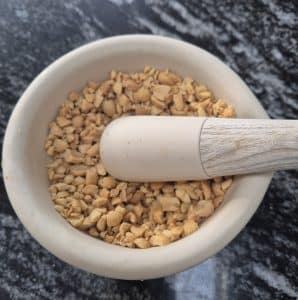
On a baking tray toast your peanuts for 5 minutes, when cooled crush the peanuts in a pestle or mortar or chop with a knife
Heat paste. Heat a tablespoon of oil in a large ovenproof casserole dish over a medium heat. Add the massaman paste with 2 tablespoons of coconut milk and gently and fry for 2 minutes, stirring constantly, until it becomes deeply fragrant. This step is worth taking your time over — it’s where the base flavour of the sauce is built.
Brown the beef. Add the beef chunks in batches and turn them in the paste until well coated and lightly browned on all sides. Don’t overcrowd the pan or the meat will steam rather than colour. Set each batch aside and repeat.

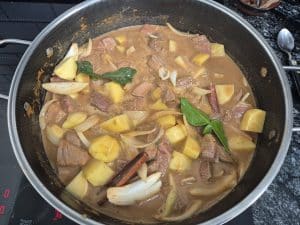
Build the sauce. Return all the beef to the casserole. Pour in the coconut milk (600ml, roughly 1½ cans) and stir to combine. Add the onion wedges, kaffir lime leaves and cinnamon stick. Then stir in the tamarind paste, palm sugar and fish sauce — these three ingredients are what balance the classic Thai flavour profiles of sour, sweet and salty. Give everything a good stir.Into the oven. Bring the sauce to a gentle simmer on the hob, then cover with a tight-fitting lid and transfer to the preheated oven. Cook for 1 hour
Add the potatoes. Remove the casserole from the oven, give it a stir and add the potato chunks, pushing them down into the sauce. Replace the lid and return to the oven for a further 45 minutes to 1 hour, until the beef is completely tender and the potatoes have absorbed all that fragrant coconut sauce. Total oven time should be 2 to 2½ hours — the beef is ready when it yields completely at the touch of a spoon.
Rest. Remove from the oven and leave to rest, lid on, for 8 minutes before serving. The sauce will thicken slightly and the beef will relax.
To serve. Taste and adjust — a little more fish sauce if it needs salt, a squeeze of tamarind if it needs sharpness, a pinch more sugar if needed. Ladle over jasmine rice and finish with sliced red chilli, fresh coriander and a scattering of roasted peanuts.